
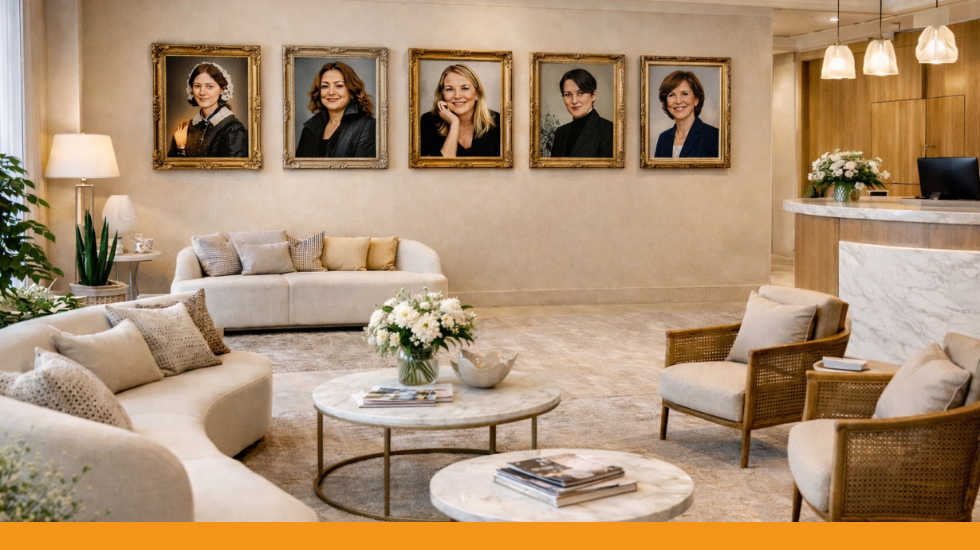
This month, International Women’s Day, gives us a meaningful reason to pause and reflect on influence. Not just who we celebrate, but whose ideas continue to shape the spaces we rely on every day.
In healthcare and commercial design, many of the principles we consider best practice today were not driven by trends or technology alone. They were shaped by women who understood early on that design affects how people feel, how efficiently teams work, and how well a space performs over time.
As a Calgary interior design firm specializing in healthcare clinic design and commercial renovations across Canada, we see this daily. The most successful projects are not defined by aesthetics alone. They are defined by clarity, flow, and long-term thinking.
This International Women’s Day, we are recognizing a few of the women whose ideas still quietly guide how healthcare and commercial spaces are designed today.
Florence Nightingale: The Foundations of Healthcare Design
Florence Nightingale was a 19th-century nurse, statistician, and social reformer whose research fundamentally changed how hospitals were designed to support patient health and safety.
Long before healthcare design became a formal discipline, Florence Nightingale was studying how physical environments influenced healing. Through observation and data, she demonstrated that daylight, ventilation, cleanliness, and clear organization directly improved patient outcomes.
What made her work so powerful was its practicality. Spaces that were easier to understand reduced stress for patients. Logical layouts supported staff efficiency. Environments designed with health in mind reduced long-term operational strain.
Modern medical office design still builds on these same principles. When clinic flow is intuitive, patients feel more at ease. When workspaces are thoughtfully planned, teams move through their day with fewer interruptions. When design supports wellness instead of working against it, clinics operate more efficiently and sustainably.
Healthcare design has always been about people first. Nightingale made that clear from the beginning.
Zaha Hadid: Expanding How We Think About Space
Zaha Hadid was an internationally recognized architect known for pushing the boundaries of form while proving that innovative design can still meet complex technical and functional requirements.
Zaha Hadid is often associated with bold architecture, but her deeper contribution was challenging conventional thinking. She questioned the assumption that function must be rigid or that creativity introduces unnecessary risk.
Her work showed that innovative thinking, when applied early and intentionally, can actually simplify complex problems.
This approach is highly relevant in commercial renovation projects, especially in regulated environments like healthcare and professional services. When design teams are encouraged to explore ideas fully at the beginning, decisions become more strategic. Fewer changes appear during construction. Timelines are protected. Budgets are respected.
Hadid’s legacy reminds us that strong design does not ignore constraints. It uses them to make better decisions.
Patricia Urquiola: Human-Centred Commercial Interiors
Patricia Urquiola is a contemporary interior and product designer whose work helped redefine commercial spaces by prioritizing comfort, ergonomics, and human experience.
Patricia Urquiola helped shift the conversation around commercial interiors by focusing on how spaces feel, not just how they function.
Her work blends ergonomics, warmth, and emotional comfort into environments that are still highly technical and performance-driven. She demonstrated that functionality and comfort are not competing goals. They reinforce each other.
This perspective is especially important in healthcare and medical office environments. Waiting room design, reception areas, and staff spaces all influence experience. A calm, well-considered space can reduce anxiety for patients and support focus and efficiency for staff throughout the day.
Design that acknowledges emotion is not decorative. It is operational.
Eileen Gray: Designing for Real Life
Eileen Gray was a modernist designer and architect who challenged rigid design conventions by creating flexible spaces based on how people actually live and move.
Eileen Gray designed around behaviour rather than ideology. She focused on flexibility, movement, and how people actually live and work within a space.
Her thinking remains deeply relevant to clinic layout planning and commercial interiors today. Spaces fail when they require users to adapt constantly. They succeed when they adapt to changing needs over time.
In healthcare clinic design, this often means planning for growth, evolving workflows, and long-term usability. A layout that continues to work years after opening delivers far more value than one optimized only for day one.
Gray’s work reminds us that good design proves itself over time.
Jeanne Gang: Leadership Through Collaboration
Jeanne Gang is an architect and design leader known for her collaborative, interdisciplinary approach to complex civic and commercial projects.
Jeanne Gang’s work emphasizes collaboration as a leadership tool. She approaches design as a shared responsibility between designers, consultants, clients, and communities.
This mindset is essential in complex healthcare and commercial projects. When stakeholders are aligned early, projects move forward with fewer disruptions. Decisions are clearer. Construction phases are smoother. Risk is reduced.
This collaborative approach mirrors how we work through our 7 step design process at Decca. When communication is strong from the beginning, projects protect both timelines and budgets.
Good leadership does not slow projects down. It creates stability.
Why This Matters This Month and Beyond
International Women’s Day is not just about recognition. It is about understanding how perspective, leadership, and lived experience shape the built environment.
Across disciplines and generations, these women shared a common approach. They designed with empathy. They thought long-term. They understood that when spaces truly support people, performance, efficiency, financial outcomes naturally follow.
These principles guide how we approach healthcare clinic design in Calgary and commercial renovation projects across Canada today.
This is not just about design.
It is about people.
And when the flow works, everything else follows.
Planning a healthcare or commercial project in Alberta?
If you are looking for an interior designer who understands healthcare regulations, clinic flow, and long-term return on design investment, we would love to help.